Waste-to-Energy Background
How Waste-to-Energy works, the technologies behind it, and why it matters for Egypt's waste and energy challenge.
Turning waste that cannot be recycled into energy
Waste-to-Energy (WtE) plants treat municipal solid waste (MSW) that cannot be prevented or recycled, and convert it into steam, electricity or hot water. The electricity is supplied to the grid for end users, and the treatment reduces the volume of waste by up to 90%.
WtE plants fall into two main categories: thermal treatment and biological processing of organic waste. Which technology a project uses depends on the characteristics of its waste feedstock. The outputs and residues also vary with the feedstock and the technology.
WtE recovers energy from waste and can reduce reliance on landfill. The biogenic share of the waste supplies renewable energy; plastics and other fossil-derived materials supply non-renewable energy. The environmental benefit depends on the feedstock, the energy recovered and the emissions controls.
Technical background: U.S. Energy Information Administration
Thermal treatment
Biological processing
From the household bin back to the household socket
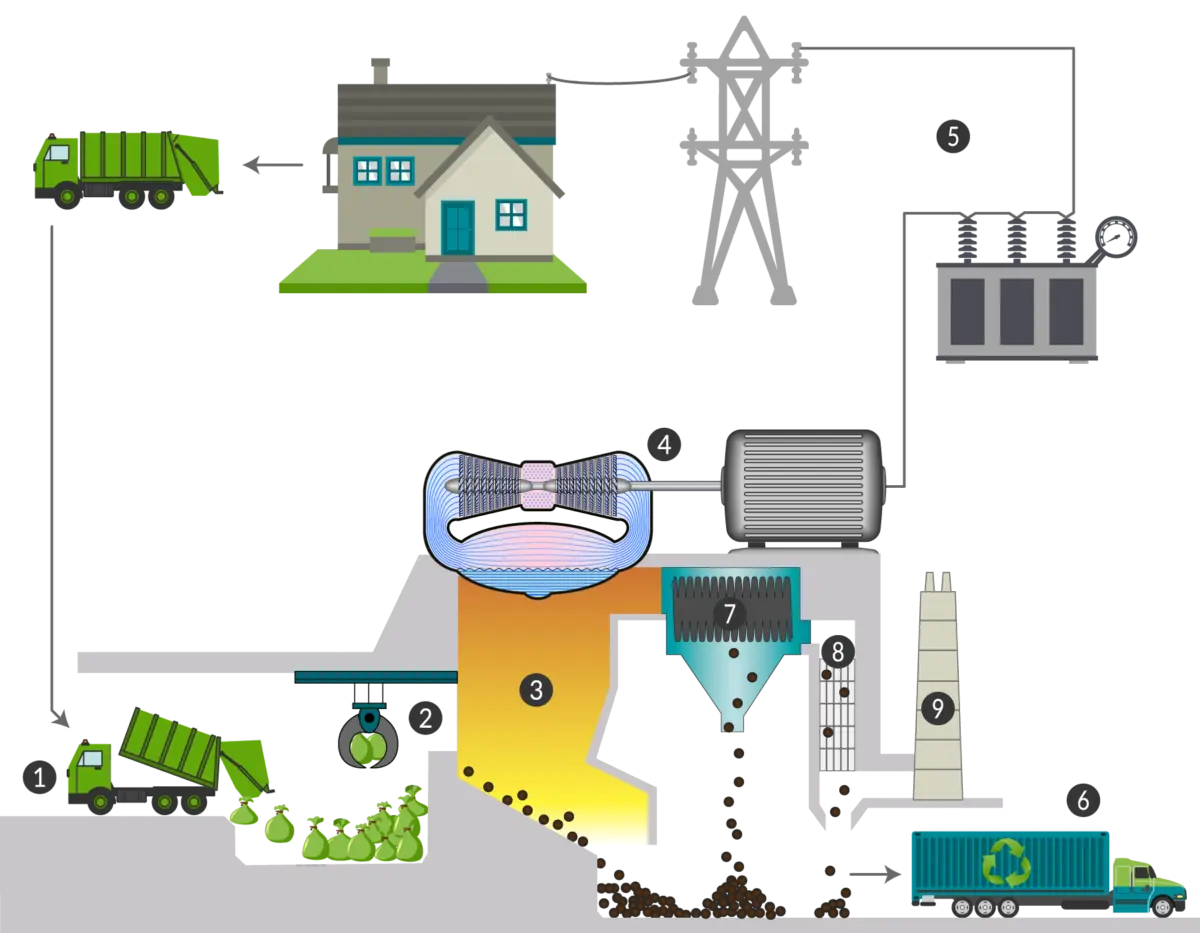
Waste collected from homes is burned in a controlled furnace. The heat drives a steam turbine, and the electricity goes back to the same homes through the grid. Ash and metals are recovered, and the flue gas is cleaned before it leaves the stack.
- 1Waste delivered by truck
- 2Waste fed into the furnace
- 3Combustion on the grate
- 4Steam turbine and generator
- 5Transformer and grid connection
- 6Ash and metals removed for recycling
- 7Boiler and heat recovery
- 8Flue gas cleaning
- 9Stack
Three thermal conversion technologies
There are three main thermal Waste-to-Energy technologies. Combustion is the most established, and is the technology used at Abu Rawash.
Combustion
Waste is heated with an excess of oxygen. Many hundreds of plants operate worldwide, recovering heat in a steam boiler to generate electricity.
Gasification
Waste is converted into a combustible synthesis gas, with plasma-arc gasification as a high-temperature variant.
Pyrolysis
Waste is thermally decomposed without oxygen. High-Temperature Pyrolysis (HTP) can turn refuse-derived fuel into power. Read more.
Mass burn on a grate furnace
"Mass burn" accepts raw or post-recycling municipal solid waste without pre-treatment, such as shredding or producing refuse-derived fuel (RDF). The waste forms a bed on top of the grate, and combustion air is injected through it.
- DryingThe waste first dries on the grate.
- DevolatilisationVolatile compounds are heated and released from the solid into the gas phase.
- CombustionThe gases burn with excess air: underfire air from below the grate, and secondary and tertiary overfire air.
- AshMainly inorganic material is left behind.
Energy recovery
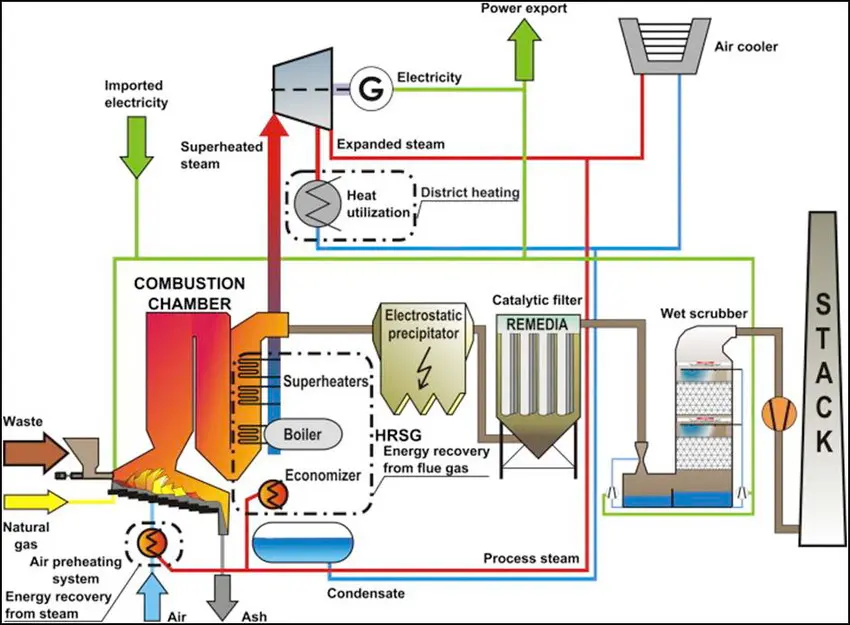
Hot flue gas from the furnace passes into a water-tube boiler, where it produces superheated steam. A steam turbine uses the steam to generate electricity. Where there is a co-located user, the steam can also go directly to an industrial process, district heating or desalination.
Flue gas cleaning
The cooled gas then passes through the Air Pollution Control (APC) system, which removes acid gases, nitrogen oxides (NOx), heavy metals and dioxins and furans before the gas leaves through the chimney.
Efficiency is lower than in fossil fuel plants because waste has a lower calorific value, and steam temperatures are limited to avoid corrosion from the acid gases that MSW combustion produces. Mass burn recovers energy from the combustible fraction of the waste. The amount of ash depends on the communities served and how much they recycle.
Two solid residues
Ash from the combustion grate. Depending on regulation and treatment, it can be reused as construction material after weathering (carbonation) or melting by plasma or slagging processes.
Fly ash from the boiler and bag filters contains hazardous compounds. It is pre-treated, stabilised and disposed of carefully in fully engineered landfills.
Multiple benefits compared to landfill
Reduces landfill waste
Combustion reduces waste volume by about 90%, so much less landfill space is needed.
Creates a significant amount of energy
Illustrative 30 MW case: around 94,254 Egyptian households, or approximately 338,000 people at 3.59 people per household. Actual supply depends on net generation and electricity use. The current Abu Rawash project targets 30–35 MW.
Recycles excess waste
Metals such as steel and aluminium are removed from the waste before combustion and recycled, shrinking the amount of unusable waste even further.
A sustainable process
Emission control by Selective Non-Catalytic Reduction (SNCR), semi-wet and dry scrubbing, Powdered Activated Carbon (PAC) injection and a baghouse filter keeps harmful gases out of the environment.
More advantages of Waste-to-Energy
- Recovery of energy and materials
- Avoidance of methane emissions
- Less odour nuisance
- More than 90% reduction in volume
- Protection of desert and seashore ecosystems
- A cleaner environment that protects health and makes the region more attractive to tourists
- New, highly skilled engineering jobs
- Up-to-date technology brought to Egypt
A growing country with a growing waste stream
The historical figures used in this background describe Egypt with nearly 105 million people in 2021, around 26 million tonnes of MSW per year and projected annual growth of 3.4% as population and consumption change.
Uncollected waste piles up around homes and businesses or is dumped into rivers and canals, where it attracts vermin, causes odours and lowers the quality of life.
Share of waste collected
Landfills are a major source of methane
In developing and lower-middle-income countries, waste often contains more than 50% degradable material. Rising MSW volumes, a high organic fraction and unofficial disposal add significantly to urban GHG emissions.
Landfills also release nitrogen oxides, dioxins, hydrocarbons and non-methane organic compounds, and their hazardous leachate can pollute groundwater. Organic waste decomposes, but non-organic waste keeps accumulating.
Compared with uncontrolled landfill, well-managed thermal treatment can avoid methane from decomposing waste and recover useful energy. Its climate benefit depends on the waste composition, emissions controls and the energy it replaces.
What landfill gas is made of
The other 1% can include hydrogen sulphide (H₂S), non-methane organic compounds (NMOCs), inorganics and, occasionally, metals. Methane has about 28 times the warming impact of CO₂ over 100 years, so it is the main focus of landfill emission control.
Waste in global emissions
Waste accounts for 3.2% of global emissions.
Reaching this goal would raise the global waste treatment rate by 10% and reduce the effects of waste pollution on health, biodiversity, food systems and resource scarcity.
Green Tech Egypt and the Renergy Group partners aim to contribute by increasing the amount of waste treated in Egypt and Africa. Waste burned in a WtE plant does not produce the methane it would create in a landfill, metals are recovered for recycling, and the electricity replaces power from coal and natural gas plants.
GTE and Renergy Group partners are developing three WtE facilities with a patented flue gas treatment unit that minimises air emissions.
What comes out of combustion
Flue gas is a complex mixture created during combustion. It can contain water vapour, carbon dioxide, particulates, heavy metals and acidic gases. It results from direct oxidation (incineration) or indirect oxidation (gasification and pyrolysis). Many of its components are greenhouse gases that trap heat in the atmosphere.
The US Environmental Protection Agency (EPA) compares gases by their Global Warming Potential (GWP): the energy one tonne of a gas absorbs over a period, usually 100 years, relative to one tonne of CO₂. The higher the GWP, the more the gas warms the earth. Some gases have a low GWP and short lifetime but are present in high concentrations, so they still contribute significantly.
| Gas | GWP (100-year) | Atmospheric life (years) | Pre-industrial (ppmv) | 2018 (ppmv) |
|---|---|---|---|---|
| CO₂ (carbon dioxide) | 1 | 5 to 200 | 280 | 408 |
| CH₄ (methane) | 28 | 12 | 0.715 | 1.869 |
| N₂O (nitrous oxide) | 265 | 121 | 0.27 | 0.331 |
| HFC-23 (CHF₃) | 12,400 | 222 | 0 | 0.000024* |
| PFCs | 6,500 to 9,200 | 10,000 to 50,000+ | – | – |
| SF₆ (sulphur hexafluoride) | 23,500 | 3,200 | 0 | 0.0000073* |
Source: IPCC (Intergovernmental Panel on Climate Change). ppmv = parts per million by volume. * Concentration in 2011.
Aiming for the cleanest WtE plant in the world
Green Tech Egypt has developed an advanced, patented flue gas treatment system that minimises air emissions from industrial processes. Professors, scientists and field experts continue to improve the technology.
Our planned plant is designed to meet the latest European air emission regulations, using advanced scrubbers, filters and an innovative flue gas treatment system. Our ambition is to make it the cleanest WtE plant in the world, out of commitment to the planet, future generations and one another.
| Pollutant | Egyptian limits 2011 | EU Directive 2010 | EU BAT 2019 |
|---|---|---|---|
| Particles (dust), mg/Nm³ | 20 | 10 | < 2–5 |
| CO, mg/Nm³ | 150 | 50 | 10–50 |
| NOx, mg/Nm³ | 400 | 200 | 50–120 |
| SO₂, mg/Nm³ | 100 | 50 | 5–30 |
| HCl, mg/Nm³ | 10 | 10 | < 2–6 |
| Cd, mg/Nm³ | 0.1 | – | – |
| Pb, mg/Nm³ | 0.1 | – | – |
| Cd + Tl, mg/Nm³ | – | 0.05 | 0.005–0.02 |
| Sb + As + Pb + Cr + Co + Cu + Mn + Ni, mg/Nm³ | – | 0.5 | 0.01–0.3 |
| Total heavy metals, mg/Nm³ | 0.5 | – | – |
| Dioxins and furans, ng TEQ/Nm³ | 0.1 | 0.1 | 0.01–0.08 |
Swipe horizontally to compare all columns.
Historical comparison: Egyptian limits (2011), the EU Directive (2010) and selected EU BAT ranges (2019). Applicable values depend on the plant and averaging period. EU waste-incineration BAT reference
Making power from refuse-derived fuel
Egyptian waste sorting plants split MSW into refuse-derived fuel (RDF), compost and reject material. On-site High-Temperature Pyrolysis (HTP) can turn that RDF into electricity.
What a sorting plant produces
Reject includes glass, rocks, dust, rubber, electronics and organic matter.
The RDF market is limited today. Its main use is industrial heat for cement production, where combustion often lacks full flue gas filtration, with significant emissions and risks to health and the environment.
RDF demand and price follow alternative energy costs such as coal and natural gas. In 2021 RDF sold for LE 150–300 per tonne, and a considerable share of sorted RDF still goes to landfill.
Using RDF on site avoids the high transport cost of this low-density fuel, and HTP can use the existing grid connection with only a transformer added. Residual ash is under 5% of the original RDF volume, cutting landfill space, disposal and transport costs. The ash may also become a by-product for the cement industry.
HTP advantages
- Clean technology
- Robust application
- Low ash volume, under 8%
- Ash can be used for building blocks
- Small land requirement, under 4,000 m²
- Commissioning within 12 months
HTP limitations
- Lower efficiency than incineration
- Higher operating costs
- Limited capacity: under 150 tonnes of RDF per day per module, with several modules possible per site
Discuss your next project with Green Tech Egypt
Tell us what you are working on. We will connect you with the right expertise.
Contact our team ↗Cairo office
5th floor, 10 Talaat Harb
Qasr El Nil, Cairo, Egypt
Contact
(+202) 25789625
(+202) 25789769
info@greentech-egypt.com